Destination timing · C24
Red Sea timing: choose your air temperature before your sea temperature
Rain barely separates Hurghada, Sharm el-Sheikh and Marsa Alam in the stored monthly series.
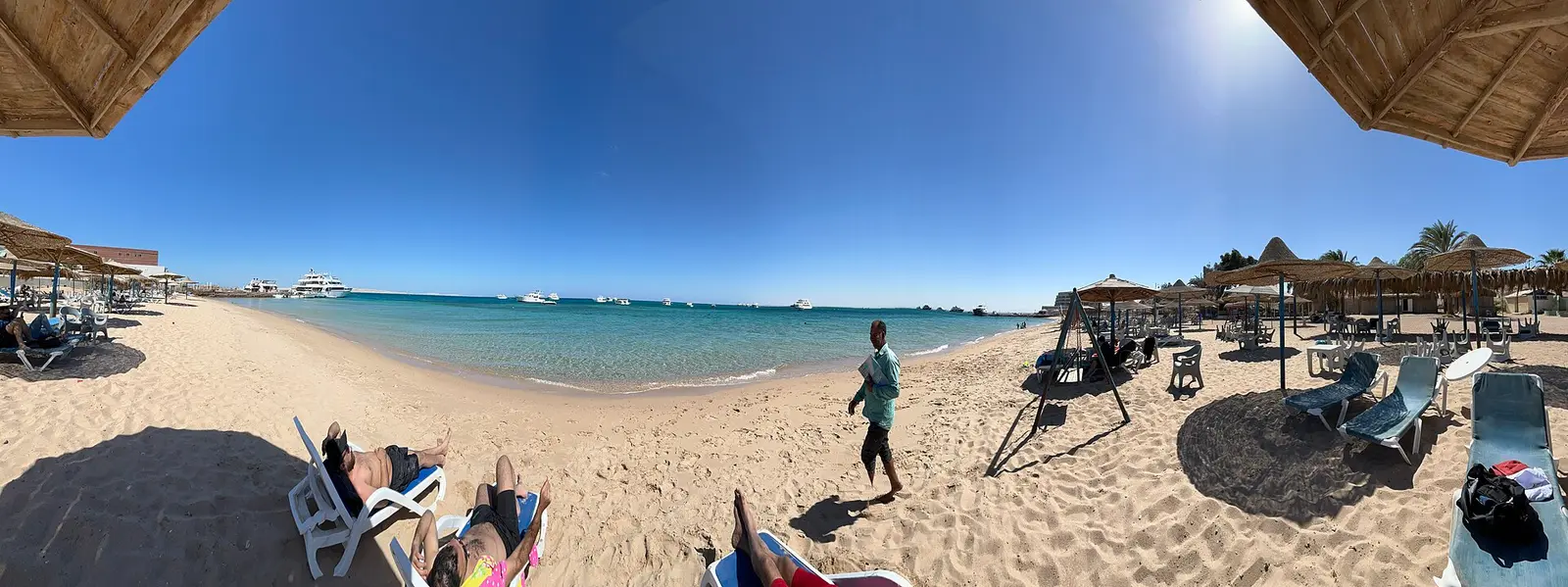
Instead of asking which resort has the best weather, set two thresholds. First decide the hottest daytime temperature you are comfortable with. Then decide how warm the water needs to be.
The temperature ladder
| comfort target | months to examine first | what the stored series shows |
|---|---|---|
| daytime highs around 22–26 °C | December to March | highest overall scores, but the coolest sea of the year |
| daytime highs around 28–30 °C | April or November | best compromise between outdoor comfort and warmer water |
| sea near its annual maximum | July and August | water near 28–30 °C, with daytime highs around 35–38 °C |
This ladder does not rank hotels, reefs or activities. It isolates the climate decision that the three destinations actually share.
Winter sun comes with a cooler sea
March is Hurghada’s highest-scoring month at 94/100; December scores 93 with a typical daytime high of 22.8 °C and sea water near 24.6 °C. Sharm el-Sheikh scores 93 in both March and December; in December, air and sea are roughly 23.5 and 24.9 °C. Marsa Alam scores 94 in March and December; December combines about 24.2 °C on land with 24.7 °C in the water.
February remains excellent overall, but the sea reaches its coolest point: about 22.4 °C in Hurghada and 22.7 °C in both Sharm and Marsa Alam. A traveller who mainly wants mild outdoor days may call that ideal. A traveller who plans long swims may prefer a later or earlier shoulder month even if the headline score is similar.
April and November solve different halves of the problem
April warms the land first. Typical daytime highs reach 27.6 °C in Hurghada, 30.1 °C in Sharm and 28.4 °C in Marsa Alam, while the sea remains near 23–24 °C. Overall scores still range from 84 to 91.
November keeps almost the same land comfort but carries summer warmth in the water. Hurghada records about 26.6 °C air and 26.3 °C sea; Sharm 27.8 and 26.6 °C; Marsa Alam 27.4 and 26.4 °C. Scores sit between 90 and 92. For travellers who want both excursions and warm swimming, November is the more interesting comparison month than the annual score alone suggests.
August wins the water column and loses the balance
The sea temperature peaks in August at about 28.6 °C in Hurghada, 29.1 °C in Sharm and 29.6 °C in Marsa Alam. At the same time, typical daytime highs reach 34.6, 38.0 and 35.3 °C. Overall scores fall to 67, 60 and 64.
Nothing is inconsistent here. The sea column answers “How warm is the water?” The overall score asks whether the full day is broadly comfortable. A heat-tolerant traveller prioritising water can still choose August rationally. The mistake would be presenting the warmest sea as a universal best month.
Is one Red Sea destination climatically better?
The differences are narrower than the seasonal swing within each place. Marsa Alam has the warmest August sea in this set, Sharm the hottest August day, and Hurghada a slightly lower peak daytime value. In November all three sit within 0.4 °C for the sea and 1.2 °C for the daytime high.
Those gaps are too small to support claims about the best diving, calmest wind, safest conditions or most comfortable hotel zone. They also do not describe a specific bay or exposed shoreline. Choose the month from the temperature trade-off; choose the resort from separate evidence about access, accommodation and the activity you intend to book.
Three defensible choices
- December to March: mild winter sun, highest overall scores, cooler water.
- November: warm sea without midsummer daytime heat.
- August: maximum water warmth, accepted in exchange for roughly 36–38 °C typical daytime highs.
There is no single correct answer because these travellers are optimising different parts of the same climate profile.
What monthly averages cannot tell you
This comparison does not forecast wind gusts, underwater visibility, currents, UV exposure or a current heat warning. It also cannot distinguish every sheltered bay from every exposed coast. Check current official forecasts and reputable local operator information before travel.
Data basis: historical monthly averages recalculated for this article for 1991–2025 under methodology p4-03-v2.1; NASA POWER for land climate, curated rainy-day inputs from the existing score series and NOAA OISST v2.1 for sea temperature. Cross-check: the Egyptian Tourism Authority’s official Egypt Tourism Guide, whose temperature table lists Hurghada and Sharm el-Sheikh separately. Not a weather forecast.
Read air, sea and overall score separately
Hurghada
Sharm el-Sheikh
Marsa Alam
Source: historical monthly averages, 1991–2025. Land: NASA POWER or the cited station series; sea: NOAA OISST v2.1. Not a forecast.
Destinations and strongest travel months
The four selected travel months:
The four selected travel months:
The four selected travel months:
The analysis uses historical monthly averages from 1991–2025, not a weather forecast. Actual conditions can vary by location, elevation and year.