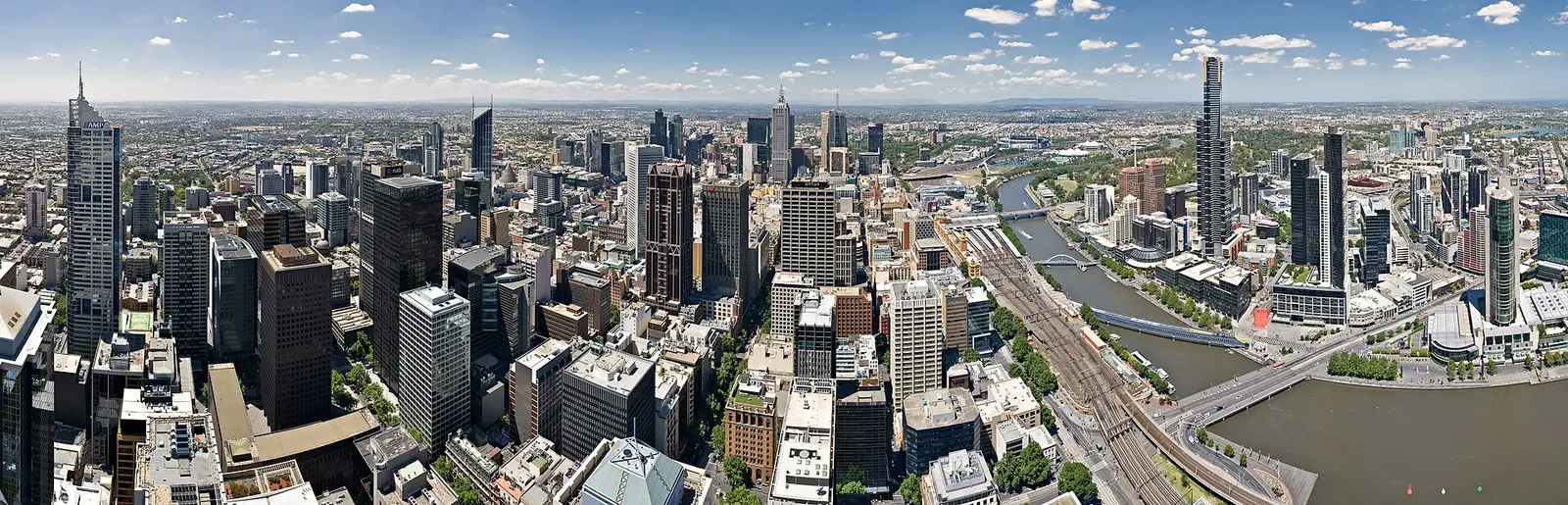
 MelbournePhoto: Diliff · CC BY-SA 3.0
Australia · Oceania
Best time to visit Melbourne
Melbourne is in the southern hemisphere and known for changeable weather. Summer (December to February) is warm, winter mild and damp. The southern summer and early autumn are best.
Climate decision
Best travel months for Melbourne
Top recommendation
Next highest scores
Historical monthly averages, not a weather forecast. Individual days and years can differ substantially.
Latest 5-year values 2021–2025
Average of the five most recent complete years compared with the 1991–2025 climate average.
October · Monthly precipitation
121.2 mm/month
1991–2025: 74 mm/month
+47.2 mm/month · higher
November · Wet days
13.6 days/month
1991–2025: 10.5 days/month
+3.1 days/month · higher
August · Mean daily maximum
14.6 °C
1991–2025: 13.6 °C
+1 °C · higher
February · Sea temperature
21.5 °C
1991–2025: 20.8 °C
+0.7 °C · higher
February: 34/141 days at or above 30 °C; highest single value 37.5 °C.
Five-year historical sample, not a weather forecast or long-term climate trend. Individual hot days can be far above the monthly mean.
Annual profile · Coast and sea
Melbourne: the swimming season follows two curves
Average daily highs vary by 12.8 °C through the year, while the sea varies by 9.6 °C. Air and water temperature should therefore be considered separately.
The practical difference
The month with the highest daytime temperature and the month with the warmest sea need not define the same travel window. Rain and sunshine help resolve the trade-off.
Warmest sea
February · 20.8 °C
Highest average daily high
January and February · 25.6 °C
Fewest rainy days
February · 6.4
Most sunshine
January · 8.9 h
Month by month
Overall suitability per month. Tap a month for details.
All climate figures compared
The table is the complete accessible data view; the charts below highlight selected patterns.
| Month | Avg high °C | Avg low °C | Rainy days (est.) | Rain mm | Sun h/day (est.) | Humidity % | Wind m/s | Sea °C | Score |
|---|---|---|---|---|---|---|---|---|---|
| January | 26 | 15 | 8 | 55 | 8.9 | 66 | 3.4 | 20 | 84 |
| February | 26 | 15 | 6 | 45 | 7.9 | 67 | 3.3 | 21 | 87 |
| March | 24 | 14 | 8 | 46 | 6.3 | 69 | 3.1 | 20 | 83 |
| April | 20 | 12 | 9 | 60 | 4.4 | 73 | 3.0 | 18 | 67 |
| May | 16 | 10 | 12 | 59 | 2.9 | 80 | 3.2 | 15 | 46 |
| June | 14 | 8 | 13 | 68 | 2.2 | 84 | 3.4 | 13 | 32 |
| July | 13 | 7 | 14 | 65 | 2.4 | 84 | 3.5 | 12 | 29 |
| August | 14 | 7 | 14 | 68 | 3.4 | 82 | 3.6 | 11 | 33 |
| September | 16 | 8 | 13 | 69 | 4.8 | 78 | 3.5 | 12 | 42 |
| October | 18 | 9 | 12 | 74 | 6.6 | 74 | 3.3 | 14 | 55 |
| November | 21 | 11 | 10 | 76 | 7.9 | 71 | 3.3 | 17 | 68 |
| December | 23 | 13 | 9 | 62 | 8.8 | 67 | 3.4 | 19 | 78 |
Climate through the year
Compare temperature, rainy days, sunshine and, for coastal destinations, sea temperature month by month.
Find a place to stay
Where to stay in Melbourne
Compare available stays, prices and cancellation terms for Melbourne on Booking.com.
Booking.comFind places to stayAffiliate link: there is no extra cost to you.
Useful next decisions
More comparisons
Similar destinations
The number is the overall climate score, not a similarity score.
Country and region
Frequently asked questions
When is the best time to visit Melbourne?
The strongest climate months are January, February, March, December. Values are historical averages, not a forecast.
Which month has the highest average daily maximum temperature in Melbourne?
Average daily maximum temperatures in Melbourne are practically tied in January and February at around 26 °C.
When is the sea warmest at Melbourne?
In February, at around 21 °C.